Computer Graphics Forum (EG 2026) - Astro-style Feature Showcase
Splat-based Metal Artifact Reduction in Cone-Beam CT via Polychromatic Modeling (Astro-style Example)
KAIST
* Demonstration page using Astro-style project components ported to Jekyll.


Abstract
Cone-beam computed tomography (CBCT) enables volumetric reconstruction from X-ray projections, but suffers from severe artifacts–especially beam hardening–when imaging materials with high attenuation such as metals. These artifacts arise from the polychromatic nature of X-rays and are not properly addressed by conventional monochromatic reconstruction algorithms. While recent neural representation-based methods offer improved reconstruction quality, they are computationally expensive and often impractical for deployment. We propose a novel physics-inspired, self-calibrating metal artifact reduction method that efficiently reconstructs 3D CBCT volumes while correcting beam hardening artifacts. Our method integrates a polychromatic X-ray projection model, material-dependent attenuation profiles, and system response modeling into a Gaussian Splatting framework. Unlike prior work, we eliminate the need for manual metal masks or strong prior assumptions, and we optimize both reconstruction parameters and X-ray spectral characteristics jointly during training. We further introduce a high-fidelity synthetic CBCT dataset generation pipeline validated on Monte-Carlo x-ray simulation toolbox and release new datasets with severe metal-induced artifacts to support the community. This is the first splat-based method for reducing beam hardening in CBCT. Extensive experiments on both synthetic and real-world datasets demonstrate that our method outperforms state-of-the-art approaches in artifact suppression and reconstruction accuracy.
Overview
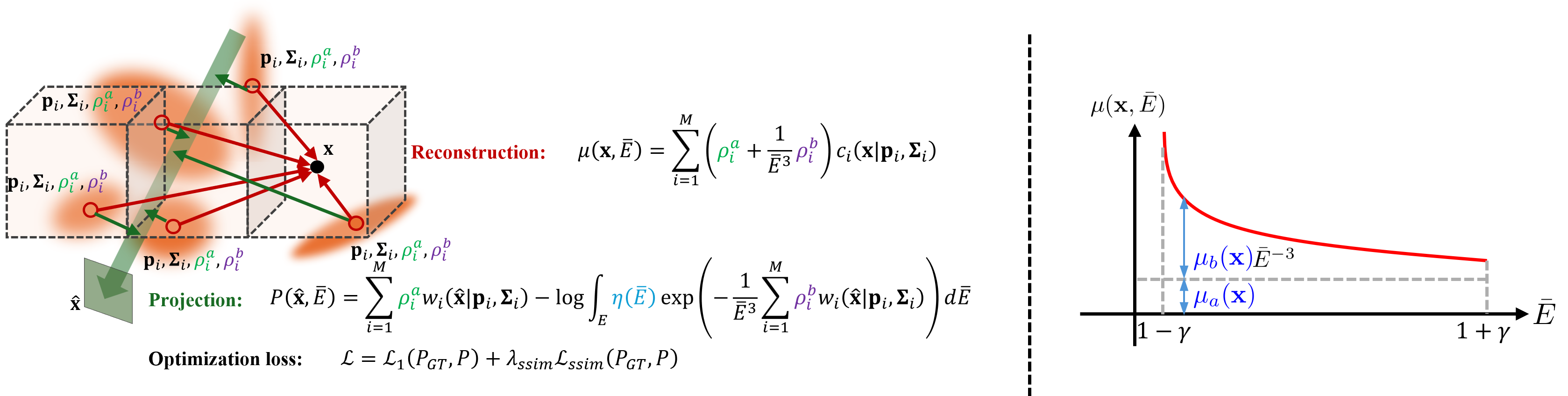
Our method jointly models projection and reconstruction by optimizing per-Gaussian material parameters together with the global X-ray response. A physics-based attenuation model decomposes material behavior into Compton and photoelectric components, enabling accurate polychromatic forward projection and effective metal artifact reduction without metal masks.
Core Idea
We reconstruct CBCT with a physics-inspired Gaussian Splatting formulation that jointly optimizes (1) per-Gaussian material behavior and (2) global X-ray spectral response. This directly addresses beam hardening from metals, avoids manual metal masks, and remains computationally practical for high-quality volumetric reconstruction.
Case Study Tabs
Ours Across Scenes

Academic Template-style Carousel
Representative FDK vs Ours
Results
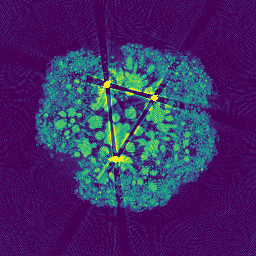
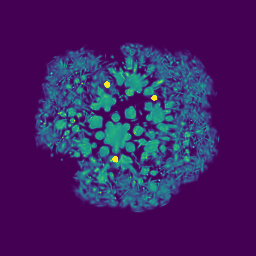
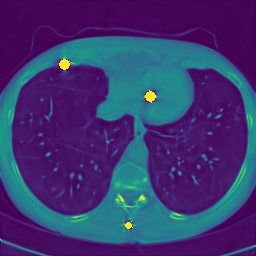
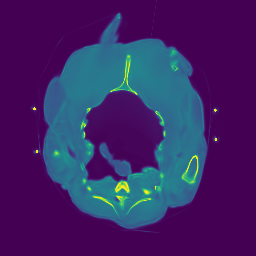
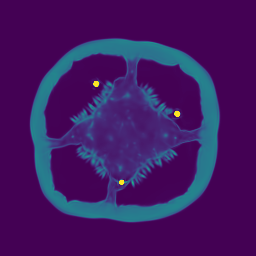
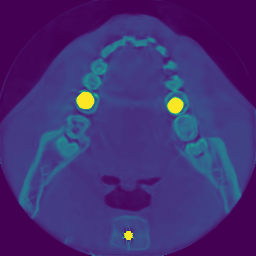
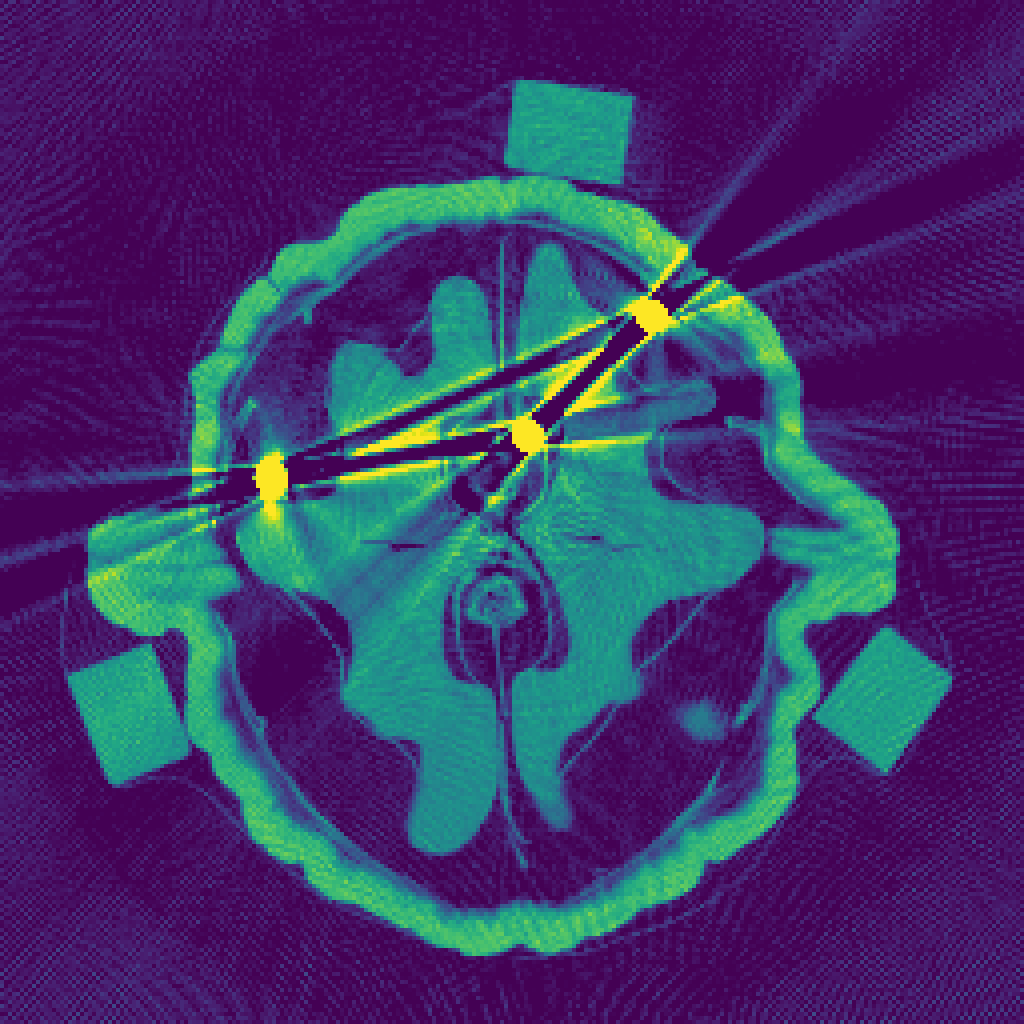
We show four real (broccoli, chicken, paprika, and walnut) and two synthetic metal-artifact reduction results. Compared with the results from FDK, our method reduces metal-induced streaky artifacts consistently across scenes.
Astro ReactCompareSlider Example
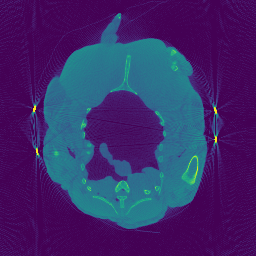
Astro-style slider powered by ReactCompareSlider.
Wide Pipeline View
Academic Project Template-style Carousel
CBCT Result Carousel
Astro Slider + Thumbnails (Scene Switch)
Real broccoli scene.
Real broccoli scene.
Additional Two-Column Example (Include-Based)
Walnut: Direct Side-by-Side
BibTeX
@Article{Choi:EG:2026,
  author  = {Kiseok Choi and Inchul Kim and Jaemin Cho and Hyeongjun Cho and Min H. Kim},
  title   = {Splat-based Metal Artifact Reduction in Cone-Beam CT via Polychromatic Modeling},
  journal = {Computer Graphics Forum (Proc. EUROGRAPHICS 2026)},
  year    = {2026},
  volume  = {45},
  number  = {2},
  pages   = {}
}
Project page template inspired by Nerfies.